DONATION"Maternity Is Not My Body's Purpose": Reclaiming the Right Not to Become Pregnant, for a World That Respects All Choices - ARTICLE - LEDGE, a specialist team for public interest litigation
"Maternity Is Not My Body's Purpose": Reclaiming the Right Not to Become Pregnant, for a World That Respects All Choices
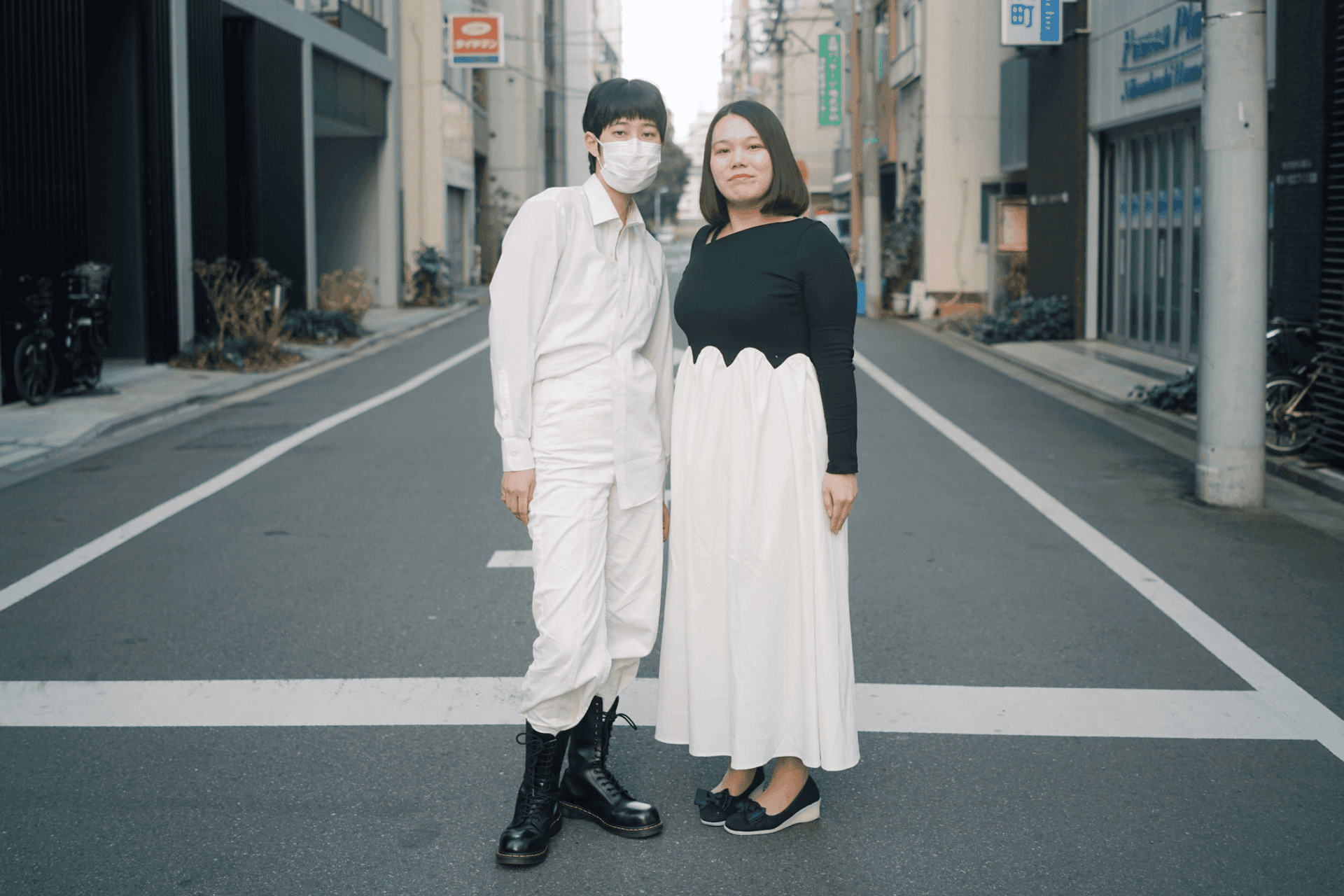
Before the Tokyo District Court ruling on March 17, we spoke with the plaintiffs in the "Maternity Is Not My Body's Purpose" lawsuit — a case brought against the state over provisions of the Maternal Health Act that deny women who wish to undergo sterilization surgery the freedom to live life on their own terms.
SHARE
Many people are familiar with the term "fertility treatment" — the medical care sought by those who face difficulty conceiving and wish to have children.
But what about sterilization surgery? Far fewer people may have heard of it.
Sterilization surgery refers to a procedure that permanently removes reproductive capacity from one's own body. Many may associate it with negative connotations, yet it is widely recognized around the world as one of the standard methods of contraception.
The "Maternity Is Not My Body's Purpose" lawsuit is a case brought by five plaintiffs — women who wish to undergo sterilization surgery in order to live life on their own terms — in a country where the freedom and rights of women who wish to remove their reproductive capacity of their own volition are denied by the state.
This is a fight to reclaim into their own hands the right to decide whether or not to give birth — the same right that underlies fertility treatment — in other words, SRHR (Sexual and Reproductive Health and Rights).
Placed on a "Train" Toward Motherhood
"I think I was a born feminist," says plaintiff Kazane Kajiya.
Kazane Kajiya, one of the plaintiffs, was a child who from an early age questioned the unspoken "common sense" that society took for granted.
Even in elementary school, when she attended her first class about menstruation, her mind filled with questions.
"When they explained menstruation to us, they said: 'Everyone's body is beginning to prepare to become a mother.'"
"By that point, I had already decided I would not have children. So being told that my own body was 'preparing' for a future I didn't want felt deeply wrong. I was shocked to find that simply being born a girl was automatically linked to falling in love with a man, getting married, and having children."
I never said I wanted to become a mother. Just because I was born female, I was placed — without my consent — on a train bound for motherhood, and apparently I'm not allowed to get off until menopause. How is that acceptable?
In high school, during a health education class, Kajiya encountered the option of sterilization surgery, and resolved to choose — for herself — the life she wanted to live.
"As long as I have reproductive capacity, I will be treated in this country as a potential maternal body, living a life I never wanted. So I thought: I would rather smash the window of that train and jump out — I'm getting off, whether they like it or not."
The Maternal Health Act: A Barrier to the Freedom to Undergo Sterilization Surgery
Yet the reality she faced was harsh.
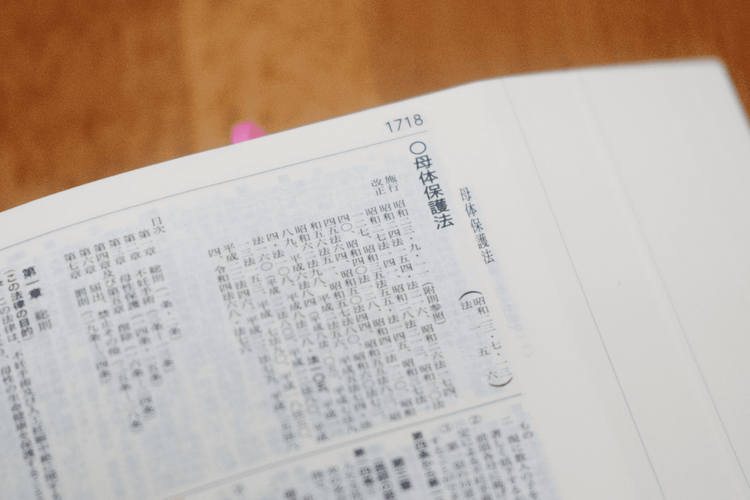
In Japan, under the regulations of the Maternal Health Act, sterilization surgery for purposes other than medical treatment is in principle prohibited.
Surgery is permitted only in one of two cases: ① when pregnancy or childbirth poses a risk to the individual's life, or ② when the individual already has several children and each delivery poses a risk of impairing her health. In both cases, spousal consent is required.
Looking beyond Japan's borders, it is one of only 8 out of 137 countries that prohibit sterilization surgery based on individual choice. WHO guidelines also recognize sterilization surgery as one of the standard methods of contraception.
After deciding she wanted sterilization surgery, Kajiya visited multiple obstetrics and gynecology clinics and consulted with them repeatedly — but was turned away at every one. She was ultimately unable to have the surgery in Japan.
She continued gathering information from overseas sources in English, and in her mid-twenties traveled abroad to receive the procedure. But that is not an option available to everyone.
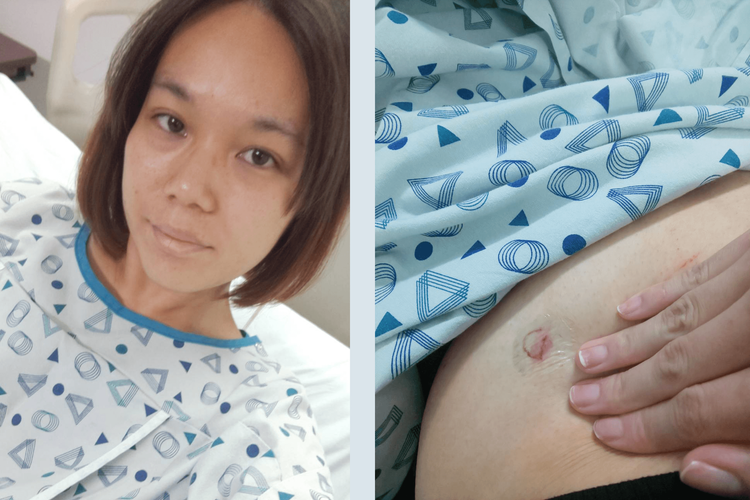
A photo taken when Kajiya underwent sterilization surgery in the United States. By around one year after the procedure, the surgical scar had healed to the point where Kajiya herself could barely notice it. | Photo courtesy of Kazane Kajiya
"When I consulted an OB-GYN in Japan about sterilization, they told me, 'You would be harming your own body,'" she recalled. "But it turned out to be a same-day procedure with low invasiveness and minimal risk. In Japan, you're subjected to exaggerated warnings designed to frighten you."
Her goal, she said, is a Japan where every person can exercise bodily autonomy — without having to cross an ocean, and without needing access to information written in English.
Each Plaintiff Has Her Own Reason
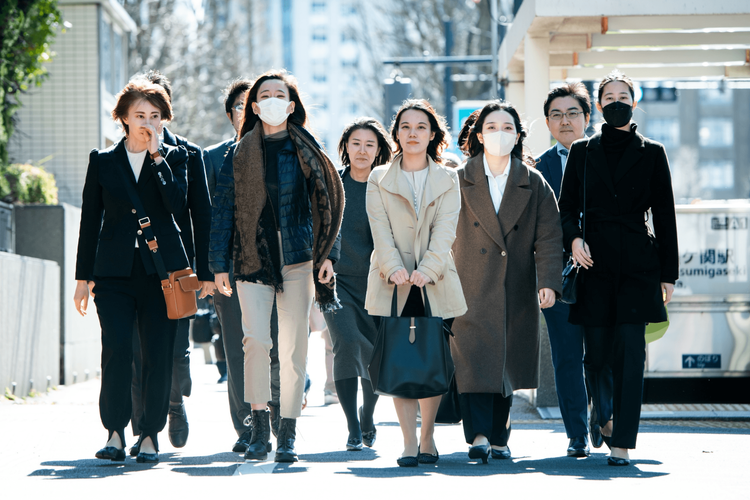
The plaintiffs and their legal team at the time of filing in February 2024.
Kajiya became a plaintiff driven by the desire to be freed from having her body — a body that has no wish to bear children — classified by the state as a "maternal body." The other four plaintiffs who have stood alongside her in the courtroom each carry their own story and convictions.
Rena Sato (a pseudonym), who is aromantic and asexual and experiences neither romantic nor sexual attraction toward men or women, wishes to live a life without a partner and without engaging in reproduction, and wants to undergo sterilization surgery.
Chifumi (a pseudonym) has said that in Japan, people who choose not to have children "are treated like they are invisible." Kuno (a pseudonym) has also stated in court her desire to live a life without children and to make decisions about her own life by her own will, without being swayed by anyone.
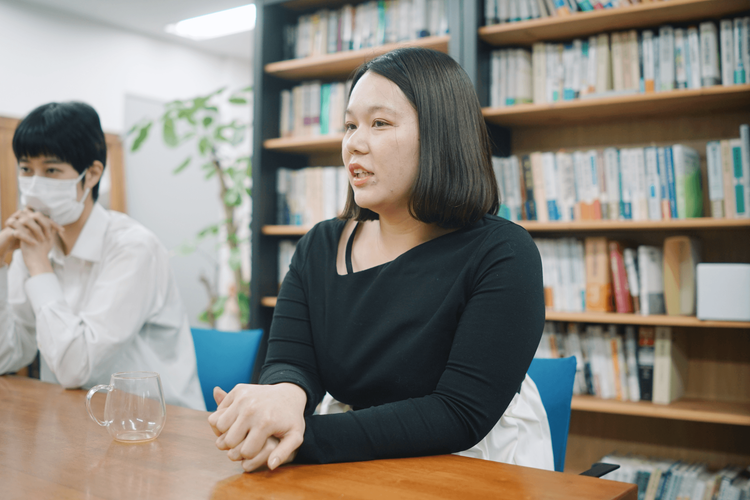
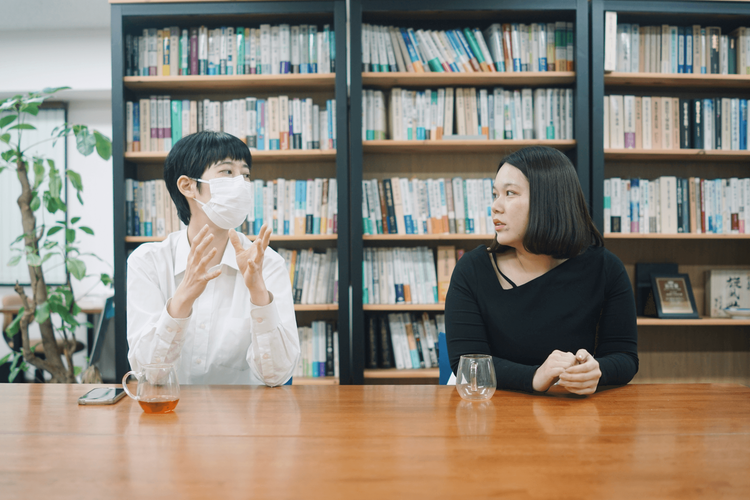
Plaintiff Tanaka speaking about her reasons for joining the lawsuit.
Tanaka (a pseudonym), also a plaintiff in this case, has continued this fight out of a desire to remove from her own body the reproductive capacity she never wanted.
She believes she should have the right to make decisions about her own body — yet she feels deep anger at a legal system that presupposes women will be treated as "maternal bodies," a reality that runs counter to everything she stands for.
In her oral statement to the court, she stated the following:
The Maternal Health Act was originally the Eugenic Protection Law. I can't help but feel that the state is still binding women alone in order to manage birth numbers. I was simply born female — and I find it truly unbearable that the choices available to me in life are being narrowed by an invisible hand.
Through this lawsuit,I long from the bottom of my heart for a future in which all people living in this country are freed from the prejudices and pressures of the state — a future in which women can live as full human beings, true to themselves, and in which men too are freed from the unwanted burdens imposed by paternalism.
"Why is it that just by being a woman, all my rights to self-determination are stripped away, and it's assumed that becoming a mother and giving birth is a given? Each one of us should be able to live our own life by our own will," Tanaka said.
"I hope we can become a society where people who want to live without children have access to every option — just as people who choose to give birth do. I want a society where no one is left behind."
The Possibility of 'Regret' After Sterilization Surgery?
More than two years have passed since the lawsuit was filed in February 2024. In response to the plaintiffs' claims, the state has emphasized the physical invasiveness of sterilization surgery and the possibility of future regret, arguing that imposing conditions and regulating access in fact "contributes to substantively guaranteeing the right to self-determination of those seeking sterilization surgery regarding whether or not to have children."
However, tubal ligation — currently the most common form of sterilization surgery — is actually less invasive than contraceptive methods such as the Mirena IUD, which requires replacement every five years.
Moreover, every person who has decided to undergo sterilization surgery has weighed every conceivable possibility and still arrived at the conclusion that they do not wish to remain in their body as it is. This is not a conclusion reached overnight. And above all, there is no basis whatsoever for prohibiting adult women from making decisions about their own bodies on their own.
Even if there were some small measure of regret in the path they chose, that is not something the state has any grounds to intervene in. It belongs solely to the person who made that choice.
'Don't Look Away' — On the Eve of the Ruling
Building a society where people can make their own choices about their own bodies is not a matter irrelevant to those who have no desire for sterilization surgery.
This lawsuit is also one that makes visible the existence of "women who do not wish to become pregnant" — a presence that has long been obscured by the Maternal Health Act.
No one can any longer say "there couldn't possibly be women who want sterilization surgery." They have seen these women — as plaintiffs — with their own eyes.
As the Tokyo District Court ruling on March 17 draws near, what are the plaintiffs thinking now?
"Don't look away," Tanaka said. "The court can easily avoid giving a direct answer, however it likes. If a ruling comes out that does not take on even a fraction of our pain — that doesn't truly engage with us — I think I'll be overcome with a sense of helplessness. But if I can read a ruling and feel that the court tried to understand us, that there was some genuine struggle behind it — that would make me happy."
"Of course, if our claims are fully affirmed, there's nothing more I could ask for. But if the answer is 'no,' I want to know why. The thought that there might be even one phrase that truly grapples with who we are — I'm actually looking forward to that."
Kajiya said she does not need "a perfect ruling." There is a hope embedded in her words: it is enough, for now, to take even one step forward in the discussion.
"Through this lawsuit, I want to convey the message that girls don't have to become mothers — they don't have to get married, they can be anything, they can live their own lives," she said. "And ultimately, I hope we can arrive at a world where those who give birth and those who do not are respected equally."
"Public lawsuits" aim to change social irrationality through the power of the judicial system. LEDGE is a team of lawyers, researchers, campaigners, and other experts formed to support these public lawsuits. We work with all people who want to live their lives in a fair society, true to themselves, to change the law forward.
Through our articles, we share the background and key issues of public interest litigation aimed at solving social problems — as well as the voices of the plaintiffs who have spoken out, and the legal teams who support them.
The "Maternity Is Not My Body's Purpose" lawsuit introduced here will receive its first-instance ruling at the Tokyo District Court on March 17. Join us in witnessing the moment of the ruling, and in seeing whether our lawsuit can help push history forward.*
For detailed information and the latest updates on the case, please visit the LEDGE case page on CALL4. We also invite your support through our crowdfunding campaign, which enables us to carry out robust legal advocacy.*
Interview and text by Reina Hokugo Photography by Saori Ibuki and Maki Amemori Editing by Saori Ibuki